
In telecommunications, downtime is expensive. And most of the time, customers don’t care why it happened. They care that it happened.
That’s why 24/7 network monitoring is more critical than ever. Whether you’re a regional ISP, fiber provider, MVNO, or enterprise telecom operator, someone needs to be watching the network around the clock.
But should that someone sit inside your company, or inside a managed service provider?
The decision between an in-house NOC vs an outsourced NOC isn’t just an operational decision. It’s also financial, strategic, and in this context, even cultural. And in many cases, it determines how fast your telecom business can scale.
So, should you outsource NOC or keep it in-house?
Let’s find out.
What is a Network Operations Center (NOC) ?
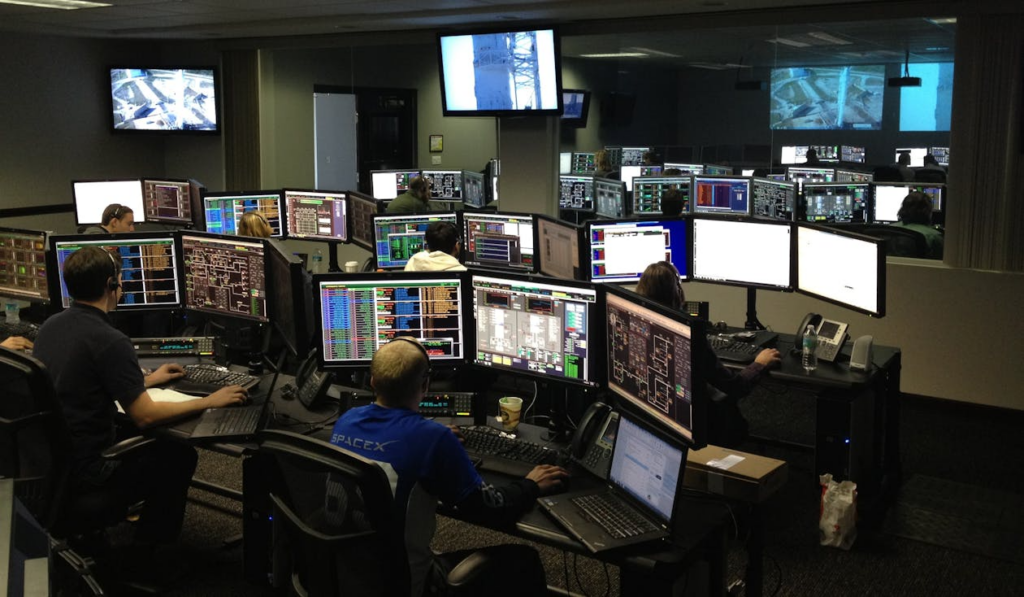
Before comparing models, we need to define the job. A modern telecom Network Operations Center (NOC) does far more than stare at dashboards. It typically includes:
- Continuous monitoring of routers, switches, fiber links, wireless infrastructure, and core network devices. This ensures anomalies are detected before customers flood support lines.
- Incident detection and ticket creation. The NOC identifies alerts, verifies impact, and logs tickets in the ITSM system.
- SLA monitoring. Performance thresholds are tracked against contractual uptime commitments.
- First-line troubleshooting. Many issues can be resolved at Level 1 without escalating to engineering.
- Escalation coordination. When deeper expertise is required, the NOC ensures the right L2 or L3 engineers are looped in quickly.
- Reporting and analytics. Weekly and monthly uptime reports, incident summaries, and performance insights help leadership make infrastructure decisions.
In short, the NOC is your network’s early warning system, and often its first responder.
Now let’s compare the two main models.
The In-house NOC Model
An in-house NOC means your telecom company hires and manages its own 24/7 monitoring team. This typically includes multiple shifts covering nights, weekends, and holidays.
Why Telecom Providers Choose In-house
The biggest advantage is control. With an internal NOC, processes align perfectly with your architecture and culture. Your engineers deeply understand your proprietary network layout. Escalation paths are direct. There’s no external SLA to negotiate because everything stays within your organization.
For large Tier-1 telecom operators or companies managing highly customized infrastructure, that level of control can feel non-negotiable.
Internal NOCs also allow tighter security governance. Access, data policies, and operational decisions remain entirely in-house.
But control comes at a cost.
The Real Challenges of an In-house 24/7 NOC
Staffing 24/7 coverage isn’t as simple as hiring three engineers. To sustainably cover 24 hours a day, seven days a week, you typically need:
- At least 5–6 full-time employees per seat to account for shift rotations, vacation, sick leave, and burnout.
- Supervisory and management oversight.
- Ongoing training for new technologies and certifications.
Recruiting skilled telecom NOC engineers is competitive. Night shifts are hard to fill, and burnout is real. Turnover can destabilize coverage.
And then there’s also infrastructure. Monitoring tools, dashboards, backup systems, office space (if on-site), and security controls add additional layers of expense.
In-house NOCs provide power, but they require long-term operational commitment.
The Outsourced NOC Model
An outsourced NOC shifts 24/7 monitoring to a managed service provider specializing in telecom operations.
Instead of building internal shifts, you contract a provider under defined Service Level Agreements (SLAs). They monitor your network, log tickets, follow your runbooks, and escalate when necessary.
Why Telecom Providers Outsource
The most obvious advantage is cost predictability.
Rather than funding multiple salaries, benefits, and infrastructure investments, you pay a managed service fee. That fee typically includes 24/7 staffing, monitoring tools, and performance reporting.
Outsourcing also reduces hiring pressure. Instead of competing for scarce telecom engineers, you tap into an existing operations team.
For growing ISPs and regional providers, this flexibility is often critical. Scaling coverage doesn’t require scaling headcount immediately.
Common Concerns About Outsourcing
Of course, outsourcing raises concerns. Some leaders worry about losing operational control. Others question security or fear vendor dependency.
These risks are real, but definitely manageable.
Clear SLAs, defined escalation matrices, strong access controls, and transparent reporting mitigate most concerns. The success of an outsourced NOC depends heavily on structure and governance.
When structured correctly, outsourcing doesn’t reduce control; simply, it redistributes responsibility.
When an In-house NOC Makes Sense
There are scenarios where building internally is justified.
Large national carriers with complex, proprietary infrastructure often require tight integration between NOC and engineering teams. If your network architecture is highly customized and constantly evolving, direct internal collaboration may be critical.
Organizations operating under strict national security or regulatory mandates may also prefer internal control to simplify compliance.
If your company already has a large operations workforce and the incremental cost of expanding coverage is manageable, in-house may align naturally.
In these cases, control outweighs cost.
When Outsourced 24/7 NOC Makes Sense
For many telecom providers, outsourcing simply makes operational sense.
Growing ISPs expanding fiber networks often struggle with night shift staffing. Regional providers balancing capital investment in infrastructure with operational expenses benefit from predictable service fees.
Telecom startups and MVNOs rarely want to build full 24/7 teams before revenue stabilizes. Outsourcing allows them to focus on customer acquisition and network expansion while maintaining uptime protection.
Outsourced NOC services also make sense during periods of rapid growth. Instead of scrambling to hire, you scale service coverage contractually.
When scalability and cost control are priorities, outsourcing often wins.
The Hybrid Model: A Practical Middle Ground
Many telecom companies don’t choose strictly one or the other. A hybrid NOC model can combine the best of both worlds.
For example, you might maintain an in-house daytime team while outsourcing overnight coverage. Or outsource Level 1 monitoring while keeping Level 2 and Level 3 engineers internal.
This approach reduces burnout, lowers cost, and preserves internal expertise where it matters most.
Hybrid models are increasingly common because they align with modern telecom realities, distributed teams, remote operations, and global customer bases.
Five Questions to Ask Before Deciding
Before choosing your NOC model, ask:
- What does one hour of downtime cost us? If the cost is extremely high, redundancy and oversight become critical factors.
- Can we sustainably staff nights and weekends without burnout? Staffing fatigue directly impacts performance.
- Are we optimizing for control or scalability? Your growth stage matters.
- Do we require deep Level 3 expertise 24/7, or mostly Level 1 monitoring?
- What does our network look like in 24 months? Decisions should align with future expansion, not just current load.
The right answer today may not be the right answer two years from now.
Why Many Telecom Providers Choose the Philippines
When telecom companies explore outsourced NOC services, the Philippines often comes up for practical reasons rather than hype.
For providers in North America, Europe, or Australia, overnight monitoring can be covered during normal working hours in the Philippines, which helps reduce the churn and fatigue that often show up in graveyard shifts. There’s also a mature technical services workforce familiar with structured monitoring and escalation environments, particularly for process-driven NOC functions like alert validation, ticket logging, initial troubleshooting steps, and clean documentation. And yes, cost efficiency plays a role, especially when you compare it to staffing multiple shifts in-house.
The Real Cost of 24/7 Coverage
Cost shouldn’t be the only factor, but it’s irresponsible to ignore it—especially in telecom, where margins can be tight and growth is capital-hungry.
Below is a simplified estimate for a mid-sized provider running a single 24/7 NOC monitoring seat. Your exact numbers will vary based on geography, wage bands, and how much you already have in place, but the structure is what matters.
Estimated Annual Cost Comparison (Single 24/7 NOC Seat)
| Cost Component | In-house NOC (Estimated) | Outsourced NOC (Estimated) |
| Base salaries (5–6 FTEs to cover shifts) | $350,000 – $480,000 | Included in service fee |
| Benefits & payroll taxes | $70,000 – $100,000 | Included |
| Training & certifications | $15,000 – $25,000 | Included |
| Supervision / management overhead | $80,000 – $120,000 (portion of manager time) | Included |
| Monitoring tools & licensing | $40,000 – $75,000 | Often included or bundled |
| Facilities / infrastructure / equipment | $20,000 – $50,000 | Typically not required |
| Total estimated annual cost | $575,000 – $850,000 | $180,000 – $350,000 |
What this table is really showing is the compounding effect of 24/7 staffing. The labor multiplier is where in-house costs balloon, because reliability requires redundancy, and redundancy requires headcount.
That said, the lowest-cost option isn’t automatically the best option.
Final Thoughts
Telecom customers don’t experience nor do they see your org chart. They, however, experience and see uptime.
An in-house NOC gives you maximum control and deep integration, but it demands serious staffing, management attention, and ongoing investment. An outsourced NOC gives you scalable coverage and predictable cost, but it requires strong governance, such as clear SLAs, runbooks, and escalation paths.
And for many providers, a hybrid model quietly delivers the best of both worlds.
The right choice comes down to what you’re optimizing for: Is it control, speed, cost predictability, or scale? Make the decision with your future network in mind and not just today’s alerts.
In telecom, the question around 24/7 coverage is whether you want to build it, or buy it, and how smartly you design it either way.