
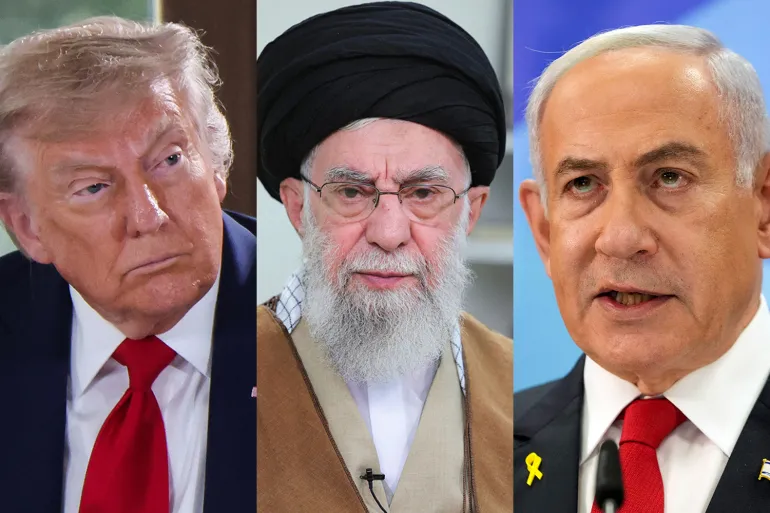
(AFP)
WASHINGTON — The United States and Israel launched coordinated strikes on Iranian targets over the weekend that killed Iran’s Supreme Leader Ayatollah Ali Khamenei, triggering Iranian retaliation across the Middle East and raising concerns in global energy and financial markets ahead of the trading week, March 1, 2026. The escalation marks one of the most significant confrontations between Washington, Tel Aviv, and Tehran in years.
Iran responded with what it described as an unprecedented barrage of missiles and drones aimed at Israel and at Gulf states hosting U.S. military bases, setting off air raid sirens, reported explosions, and widespread travel disruptions.
President Donald Trump framed the strike as a strategic turning point. “It’s the single greatest chance for the Iranian people to take back their Country,” Trump wrote on Truth Social. He warned that “heavy and pinpoint bombing will continue, uninterrupted throughout the week or, as long as necessary to achieve our objective of PEACE THROUGH THE MIDDLE EAST AND INDEED, THE WORLD!”
In another post, Trump cautioned Iran to “HIT THEM WITH A FORCE THAT HAS NEVER BEEN SEEN BEFORE,” if Tehran escalated further.
Iran’s Islamic Revolutionary Guard Corps said it was targeting U.S. bases and assets across the region under an operation it called “True Promise 4,” according to Iranian state media. Iranian officials warned of harsher retaliation if strikes continue.
Oil risks dominate market focus
Energy markets immediately turned volatile, with investors watching for disruption to Iranian production and shipping through the Strait of Hormuz, the narrow waterway linking the Persian Gulf to global markets. Oil prices jumped as the conflict intensified.
Bob McNally, president of Rapidan Energy and a former White House energy adviser, said crude could rise $5 to $7 per barrel when full liquidity returns if tensions persist.
The U.S. Energy Information Administration has said roughly 20 million barrels per day pass through the Strait of Hormuz, accounting for about one-third of global seaborne crude exports. A prolonged disruption could push prices sharply higher, potentially above $100 per barrel, analysts warn.
Defensive positioning builds across assets
Early trading indicators pointed to “risk-off” positioning: oil and gold higher, equity futures weaker and the U.S. dollar strengthening as investors sought safe havens.
Market attention is focused on whether crude sustains its gains, whether the dollar strengthens against Asian currencies sensitive to energy costs, and whether equity selling broadens beyond trade-exposed sectors.
A sustained oil spike could lift inflation expectations and pressure oil-importing economies, particularly in Asia, where several countries rely heavily on crude shipments through Hormuz.
Regional retaliation and travel disruption
Airspace closures across parts of the Middle East disrupted major transit hubs. Airlines suspended or rerouted flights amid security concerns, with thousands of cancellations reported over the weekend. Airports in Dubai and Abu Dhabi experienced operational disruptions following regional strikes.
The widening conflict has raised fears of a broader regional war involving Gulf states that host U.S. forces.
How the world responded
World leaders called for restraint and de-escalation.
“The use of force by the United States and Israel against Iran, and the subsequent retaliation by Iran across the region, undermine international peace and security,” U.N. Secretary-General António Guterres said. “I call for an immediate cessation of hostilities and de-escalation.”
U.N. human rights chief Volker Türk warned of civilian harm. “As always, in any armed conflict, it is civilians who end up paying the ultimate price,” Türk said, adding that protecting civilians is “paramount” under international law.
European leaders urged diplomacy. “We condemn Iranian attacks on countries in the region in the strongest terms,” French President Emmanuel Macron, German Chancellor Friedrich Merz and British Prime Minister Keir Starmer said in a joint statement. “We call for a resumption of negotiations and urge the Iranian leadership to seek a negotiated solution.”
Canadian Prime Minister Mark Carney expressed support for U.S. efforts to prevent Iran from obtaining a nuclear weapon, while other governments, including Spain and Oman, called for immediate de-escalation and renewed talks.
With markets reopening amid heightened uncertainty, investors and policymakers are bracing for further volatility, particularly in oil, that could ripple through inflation, currencies and global growth if the conflict widens.