
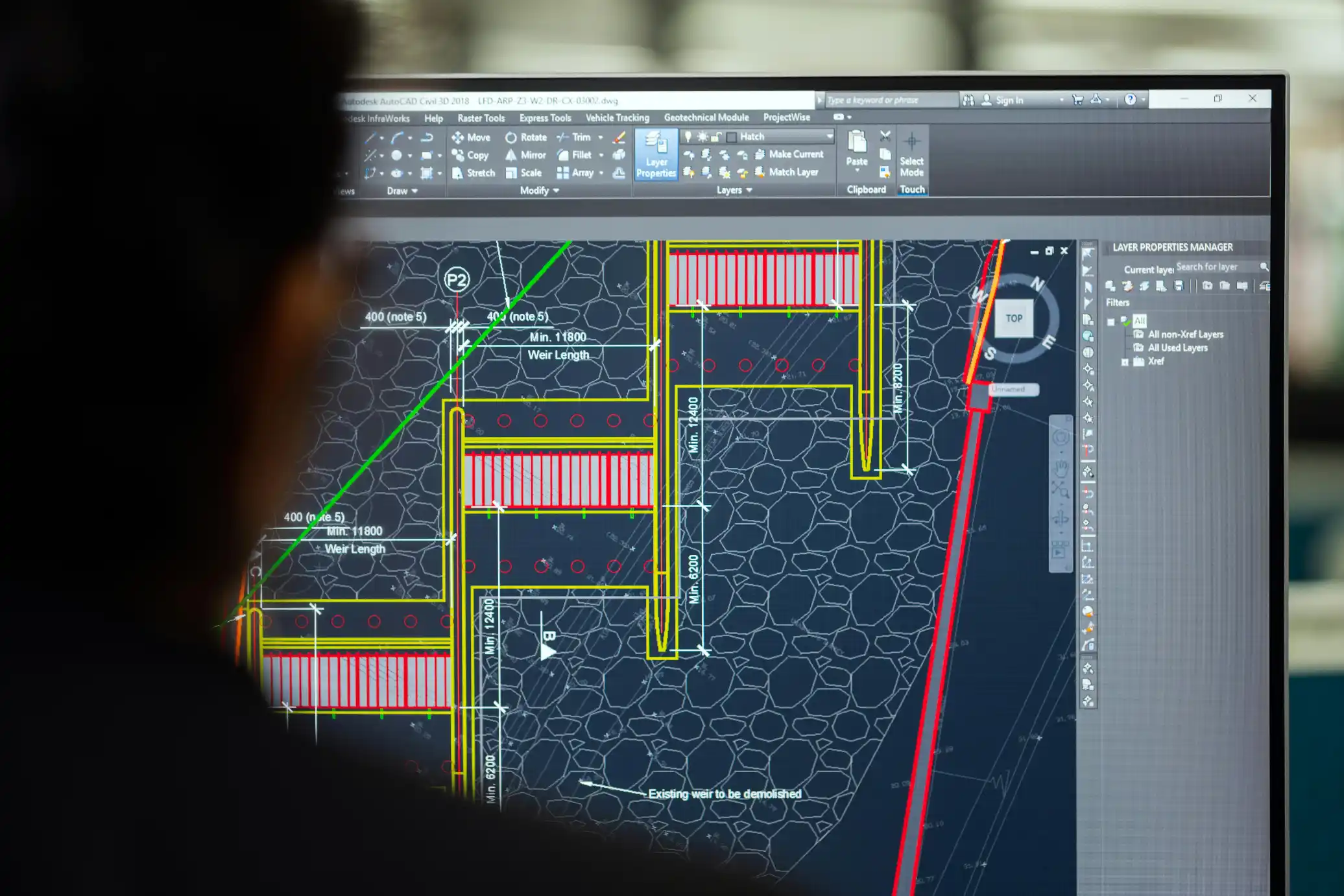
AI can draw lines faster than any human, but can it interpret an RFI or navigate a tricky building code?
In 2026, CAD professionals, especially Filipino CAD experts, are stepping up outside their work as mere drafters. They are now blending automation with their human judgment to transform how engineering and manufacturing currently work.
How it was with Traditional Drafting
Traditionally, CAD drafters were tasked with creating technical drawings, updating revisions, managing BOMs (Bills of Materials), and following markups from engineers.
Now? Those tasks are increasingly handled, or at least accelerated, by Agentic AI systems.
So, where does that leave the human? Right at the center of decision-making. And because of these, Filipino CAD professionals are doing less traditional drafting and more high-level management, like interpreting RFIs and coordinating among architects, engineers, and on-site teams.
In such a short period of time, they’ve gone from being the executors to simply conductors.
What is Agentic AI?
Agentic AI refers to AI systems that do not just run on commands. They take initiative within defined goals. Think of them as digital assistants that can auto-generate drawing iterations, update BOMs based on design changes, and flag inconsistencies across documents.
In manufacturing ops, this could mean faster drafting cycles, reduced manual errors, and most importantly, real-time updates across systems.
But, and this is a big but— Agentic AI lacks contextual judgment. If doesn’t understand why a contractor is pushing back, and it cannot negotiate between conflicting stakeholder priorities.
And so, you need human intake, especially high-EQ talent.
Why High-EQ Talent?
Technical skills alone aren’t enough anymore. It’s already 2026, and in complex manufacturing environments, success depends heavily on clear communication, cultural awareness, and great problem-solving.
That is where Filipino CAD experts have a distinct edge. They are known for high English proficiency and a strong collaborative mindset. They also have a long history of working across global teams and are uniquely positioned to act as bridges between designers and engineers, office teams, and onsite contractors.
An AI system can update the BOM after a design tweak, yes. But a Filipino CAD specialist notices a material substitution might not be locally available, or that a dimension change could conflict with a regional building code.
That is contextual intelligence at play. And that’s not something AI can flag easily.
The Rise of AI Conductors
Think of modern CAD professionals as orchestra conductors. The instruments? The Agentic AI tools, CAD software, the data systems, and communication platforms.
The conductor? A skilled human who ensures everything works in harmony. And Filipino CAD experts are stepping into this role seamlessly.
They can delegate repetitive tasks to AI, oversee outputs for accuracy and compliance, and adjust workflows in real-time.
Instead of being replaced, they can actually become what we call the force multipliers.
FAQs
Will AI completely replace CAD drafters?
Not quite. AI will handle repetitive tasks, but human expertise is essential for interpretation, coordination, and decision-making.
What makes Filipino CAD experts unique?
Their combination of technical skills, English proficiency, and high emotional intelligence makes them ideal for global collaboration and AI-integrated workflows.
What is Agentic AI in simple terms?
It’s AI that can take initiative, automating tasks and making suggestions rather than just following fixed commands.
Is outsourcing manufacturing CAD services still relevant in 2026?
Absolutely. In fact, it’s more strategic than ever, especially when combined with AI-enabled processes and high-quality talent.