
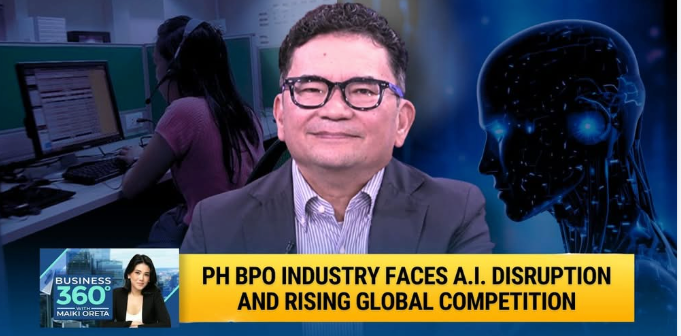
The Philippine IT and Business Process Management sector closed 2025 ahead of global growth and crossed a major economic milestone, according to Information Technology and Business Process Association of the Philippines President (IBPAP) and CEO Jack Madrid.
In a recent interview with Bilyonaryo News Channel, Madrid said the industry outpaced global IT BPM growth by five percentage points and added 80,000 new jobs for Filipinos.
The sector also now contributes 8.5 percent of national GDP and remains one of the country’s largest formal employers, with 1.9 million digital Filipino workers.
Crossing a major milestone of $40B contribution to the economy, the Philippine BPO industry hit its 2025 target of $40B. For 2026, the new revenue target is a mid single-digit of $42B. Madrid attributed this low stretch to the current transformative phase in the industry.
“What took us to where we are today will not be enough to take us where we want to be,” Jack Madrid said.
“I see some positive growth happening in 2026, but as we all know, transformative technology like Generative AI and Agentic AI will change the way we work, will create new work types, and hopefully, will create higher complexity and higher-value processes,” he added.
Beyond Labor Arbitrage
Madrid described BPO as “an indispensable pillar in the economy,” noting that the sector’s $40B contribution reinforces its position alongside overseas Filipino workers as a core source of foreign exchange. He also emphasized the growing role of digital Filipino workers who deliver services remotely into global markets.
Factually, three data points defined 2025:
- $40B in industry revenue, meeting the 2025 target
- 80,000 net new jobs added
- 8.5 percent contribution to the Philippine GDP
This industry’s performance came despite global uncertainty and increased competition from emerging delivery destinations such as Poland, Egypt, South Africa, Colombia, and Vietnam.
In addition to the increasing competition in IT-BPM locations, Madrid also noted the AI shift being underway.
According to him, our call centers, contact centers, and voice services relied on the country’s ability to hire people at scale. This is the labor arbitrage phase.
The next phase, Madrid argued, is about capability arbitrage. In practical terms, global clients are no longer choosing the Philippines only for cost and English fluency. They are looking for domain expertise, digital skills, and technology-enabled service models.
From Gen AI to Agentic AI
Distinguishing Generative AI from Agentic AI, Madrid has this to say, “Think of Generative AI as a copilot that will assist the agent [in augmenting] the job, providing data faster and more efficiently, and as a result, higher productivity but also higher customer satisfaction.”
Agentic AI, on the other hand, represents a deeper shift.
“[It is] more autonomous,” Madrid said. “If you train it and build it properly, it will be capable of managing an entire workflow.”
In a BPO context, this may include orchestrating multi-step processes across systems, escalating exceptions, and coordinating outcomes, ideally with human oversight at the core.
Considering that the industry is heavily reliant on outsourcing people at scale, Madrid acknowledged employee fears about job displacement because of AI.
“I would view the call of the hour [as] learning to be more digitally literate,” Madrid explained. According to him, Digital Filipino Workers (DFW) need to learn how to work with AI rather than worry about the jobs being disrupted by AI.
He stressed that Filipino skills like communication, comprehension, empathy, creativity, and leadership are becoming more important in this day and age of AI. In parallel, he also highlighted the need for DFWs to develop deeper domain skills in accounting, engineering, and banking.
The Rise of GCCs and Higher Complexity Work
Another notable trend highlighted in the interview with the IBPAP CEO is the expansion of Global Capability Centers, or GCCs. Unlike traditional outsourced models, GCCs are captive operations with no third-party intermediary.
India currently hosts more than 1,000 GCCs, compared to more than 100 in the Philippines. Madrid believes the Philippines is well-positioned to expand its share, particularly in banking, financial services, and healthcare, where Filipino talent has developed strong domain depth.
Responding to the question about the renewed interest in GCCs, Madrid cited several factors, including tighter control over data privacy, closer alignment with the voice of the customer, and internal governance preferences in certain sectors. Some enterprises prefer employees directly on their payroll rather than outsourced staff, especially for sensitive financial and healthcare processes.
For the Philippine ecosystem, this creates a dual-track reality. Third-party providers must move up the value chain into complex, technology-integrated services. At the same time, the country must make it easy for multinational firms to establish and operate captive centers.
Regional Expansion and Competitive Pressure
Geographically, the industry continues to decentralize. Before the pandemic, only about 25 percent of the BPO workforce was outside Metro Manila. That figure now stands at roughly 33 percent, reflecting growth in tier two and tier three cities.
When asked to name the next IT BPM hub, he pointed to one city: “Iloilo.”
However, competitive pressure is intensifying. The Philippines and India remain the top two global IT BPM destinations, but they are no longer the only serious contenders.
“We have Poland, Egypt, South Africa, Colombia, [and] Vietnam wanting to take away some of the market share from us,” Madrid shared.
Another concern highlighted by Madrid is the persistent perception issue.
“We need to address the perception that the Philippines does not have deep technology talent,” Madrid said, noting the presence of technology companies in the Philippines, such as Accenture and IBM.
Addressing this perception, he suggested, will require visible investment in AI literacy and advanced technical training.
Madrid also noted the need to address the ease of doing business in the country.
“We need to welcome investors and make good on the promises we made them when they decided to invest in the Philippines,” Madrid said.
He also added that, “We need to implement and interpret rules and regulations consistently and not confuse and distract our investors from running their business with changing rules in the middle of the game.”
2026 in one word: “transforming”
Madrid’s closing summary was simple.
“One word to describe the industry in 2026: transforming.”
And the industry’s biggest upside and mandate?
“Biggest opportunity in 2026: talent upscaling,” he said. The core skill young Filipinos should build is AI literacy,” he ended.